

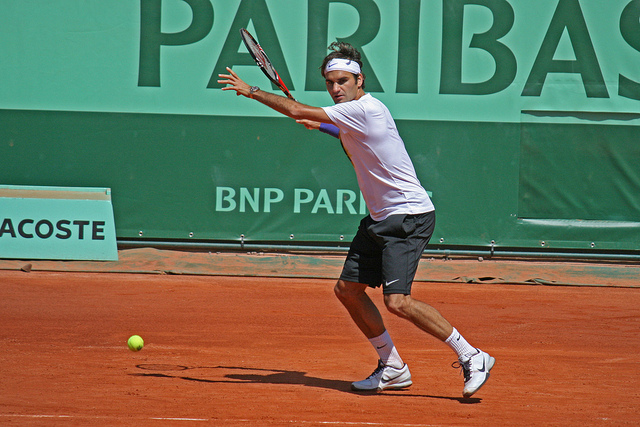
Roger Federer’s Forehand is perhaps one of the greatest forehands graced by the game of tennis in recent years. Despite his retirement, Federer’s forehand is known to be one of the greatest of all times not only because of his grace of technique but also the smoothness adaptability, sheer power and topspin that his forehand provided.
Of all the top players that I’ve studied in slow motion, Roger Federer’s forehand easily ranks top amongst them all. The biomechanics in his forehand technique allowed him to handle high pressure situations and dominate his opponents on the tennis court
Unit Turn
Similarly to all other top pro players on tour, Roger Federer began his forehand with a classic ATP style unit turn. The unit turn is essentially a way that begins the forehand stroke using the entire body as a kinetic chain, rather than just the arm or racket.
Notice how Federer’s forehand begins with him cradling the throat of his racket and turning his whole body as a whole like a “unit” hence where the name unit turn comes from.
The mistake that most club level players make is starting their take back using the arm and racket rather than their whole body together as one unit, which kills most of the power in their swing
Federer’s Forehand Body Coil and Height of Take back
Federer’s forehand technique and biomechanics start not just from the unit turn, from also leading into the height of take back. Notice Federer keeps his arm and racket on the same side of his body while keeping the wrist is a slightly neutral and pronated position. This is key to Roger Federer’s forehand because now rather than using his arm and racket to power the stroke, Federer is coiling his body like a spring in preparation for contact.
Notice how his top of his left shoulder is pointed towards the opponent, and his arm is fully stretched across the baseline parallel to the court. This ensure that Federer obtains adequate coil and stores enough potential energy for later on in the swing.
Straight Hitting Arm Position
One element that distinguishes Federer’s forehand from the rest of the players on tour is the notion of the “straight-arm hitting position” which entails Federer’s hitting arm position at contact virtually straight, compared to a “double bend” hitting arm position which is the classic hitting arm position at contact for virtually all other pro players on tour.
The straight-arm forehand allows Federer to achieve much greater torque and velocity which is the effect that we call the “heavy topspin” forehand whilst still maintaining a more conservative eastern-style tennis grip.
Contact Point – Remarkable Head Position
At contact, Federer appears perfectly relaxed keeping his racket perfectly parallel and in line with the net.
Federer’s head position is also remarkable in that he keeps his head almost completely locked and still during the point of contact with his eyes laser focused on the contact point. This prevents him from hitting any mishits and keeps him locked onto the contact point to ensure a clean hit every single time
Federer’s Windshield Wiper Followthrough
Federer’s windshield wiper forehand followthrough is a classic blend of modern mechanics with classical elements. Note how Federer forehand involves him peeling the ball, like the blades of a windshield wiper of a car pushing the rain away, hence the name “windshield wiper forehand.”
This forehand followthrough allows top pro players to enhance their topspin while maintaining good velocity and speed on the ball, increasing their margin of error and giving the ball the heavy topspin effect that is often noted in the modern game of tennis.
Gone are the days of “pushing the ball” with the racket and finishing way high above the opposite shoulder. Rather than shoving the ball, Federer peels the ball with his arm and racket delivering a true heavy topspin forehand.